
A Garland home with more than one slow or gurgling drain, or sewage odor showing up near a yard cleanout, usually has a problem in the line running toward the street, not in a single fixture.
Garland has a defined permit process for sewer relay and repair work, with specific requirements for slope, bedding, cleanouts, and who is allowed to pull the permit. Understanding that process matters before any digging starts on a Garland property.
This page covers how we diagnose and repair sewer lines for Garland properties, what the City's own permit requirements say about sewer repair work, and what to expect when you call 214-257-2060 or request service online.
Signs your sewer line needs attention
Multiple slow or gurgling drains, sewage odor near a cleanout or low spot in the yard, and water backing up into a tub or floor drain when the washing machine runs are signs of a main-line issue rather than a single clogged fixture.
A soggy or unusually green strip of lawn tracking toward the street, along with clogs that keep returning in the same location despite snaking, often indicates a structural defect in the pipe rather than a one-time blockage.
Camera inspection and line locating
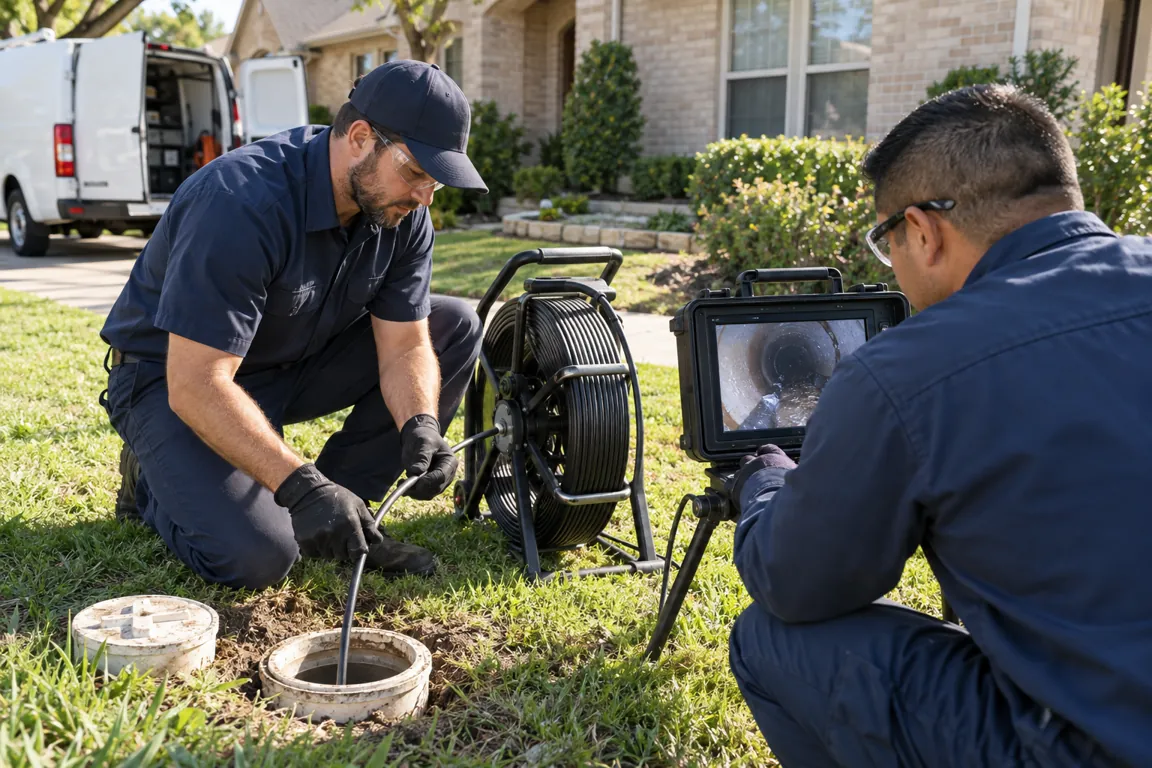
Before recommending any repair, we run a sewer camera through the line to see the actual pipe condition — cracks, offset joints, bellies, root intrusion, or a collapsed section — rather than guessing from surface symptoms.
Locating the line matters for any digging in Garland. A Texas811 request covers public utility locates, while a licensed plumber or private locating service is needed to mark sewer and water lines on private property, since public locators don't mark private-side lines.
Repair options we evaluate
Hydro jetting and blockage removal
When the camera shows grease, scale, or root mass without structural pipe damage, hydro jetting clears the line without excavation. It resolves blockages, not cracked or collapsed pipe.
Trenchless repair where the pipe allows it
Trenchless lining can work when the existing pipe keeps a consistent shape and enough structural integrity to support a liner. A collapsed run or heavy misalignment usually rules this out.
Spot repair
When the camera shows one isolated failure — a cracked joint or short collapsed section — a spot repair addresses only that section rather than relaying the full line.
Full replacement (sewer relay)
A line with repeated failures, widespread root intrusion, or an old pipe that fails the required slope can call for a full relay. Garland's permit process treats replacement of any portion of a sewer line as permitted work.
Emergency response
Active backups or sewage surfacing in the yard need prompt attention. We prioritize these calls, though we don't promise a specific arrival window — each day's schedule depends on jobs already underway.
Garland's sewer relay permit requirements
Garland requires a permit for replacement of any portion of a sewer line, through its Sewer Relay/Repair Permit Application. The permit fee is $88 ($70 plus an $18 processing fee) whether a homeowner or a licensed contractor pulls it.
A homeowner may pull a Homeowner's Affidavit and complete the repair personally only if they own the home, live in it, and hold a homestead exemption on it through the Dallas Central Appraisal District, verified by the City. Otherwise, a State-licensed master plumber registered with the City of Garland must take out the permit and complete the work — and for rental properties, a registered master plumber is required with no exceptions.
Garland's permit requirements set technical standards for the work itself: the sewer line must maintain a slope of at least 1/8 inch of fall per foot, must be properly bedded on the bottom and sides so the slope holds through backfill, must include a two-way cleanout close to the house, and must extend at least one foot past the property line. If the line is relocated and needs a new sewer tap, a separate fee is paid to the Water Department.
These standards mean the City inspects not just that a line was repaired, but that it was built to maintain correct drainage slope and has a cleanout positioned for future access and testing, which is why coordinating repair work with an eye toward passing City inspection matters as much as clearing the original blockage.
Repair vs. replacement decision
The camera inspection drives this decision. A single defect in an otherwise sound line usually supports a spot repair or trenchless lining. Multiple defects, a pipe that can't maintain the required slope, or clogs recurring in different spots despite jetting usually point toward a full relay.
We walk through the camera footage with you so the reasoning behind the recommendation is visible rather than just asserted.
What affects your estimate
Several factors shape the scope of a sewer repair in Garland: the length of pipe affected, depth and accessibility, whether a new sewer tap or relocation is involved, pipe material and diameter, and whether the existing cleanout placement meets the City's requirements or needs to be added.
We don't publish flat prices because every property's layout and line condition differ. You'll receive a written estimate based on the camera findings before any repair work begins.
What to expect when you request service
Call 214-257-2060 or submit the online form to describe what you're seeing. We follow up with a camera inspection to see the actual pipe condition rather than guessing from surface symptoms.
After the inspection, you'll get a written estimate explaining the recommended repair method and why, before any work begins. We don't promise exact arrival windows or guarantee zero disruption to your yard — sewer repair work, by nature, involves some digging or access to the line, and permitted relay work must still pass City inspection.
Common Questions From Garland Homeowners
Do I need a permit for sewer line repair in Garland?
Yes. Garland requires a Sewer Relay/Repair Permit for replacement of any portion of a sewer line, with a permit fee of $88 regardless of whether a homeowner or contractor applies for it.
Can I pull my own sewer repair permit in Garland?
Only if you own and live in the home and hold a homestead exemption through the Dallas Central Appraisal District, verified by the City, can you pull a Homeowner's Affidavit and do the work yourself. Rental properties must use a State-licensed master plumber registered with Garland, with no exceptions.
What technical standards does Garland require for a sewer relay?
Garland's permit requirements call for a minimum slope of 1/8 inch of fall per foot, proper bedding to maintain that slope through backfill, a two-way cleanout close to the house, and the line extending at least one foot past the property line.
Does relocating my sewer line require anything extra?
Yes. If the line is relocated and needs a new sewer tap, Garland requires a separate fee paid to the Water Department in addition to the sewer relay permit itself.
Does a camera inspection cost extra before I get an estimate?
We run the camera inspection first because it's the only reliable way to see what's actually wrong with the pipe. You'll receive a written estimate based on that inspection before any repair work is authorized.
How is hydro jetting different from a structural repair?
Hydro jetting clears grease, scale, and root growth from a pipe that is otherwise structurally sound. It does not fix a cracked, offset, or collapsed pipe — that requires a spot repair, lining, or relay depending on what the camera shows.
Related Services and Guides
- Trenchless Sewer Repair
- Sewer Camera Inspection
- Sewer Line Replacement
- Sewer Spot Repair
- Tree Roots in Your Sewer Line: A Dallas Homeowner Guide
- Trenchless vs. Traditional Sewer Repair for Dallas Yards
- 7 Signs Your Sewer Line Is Broken (Not Just Clogged)
Also nearby: Richardson, Mesquite, Carrollton · back to our Dallas sewer repair overview.
Local Resources
Official pages are listed for reference. We are an independent plumbing service, not affiliated with the Garland municipal government.