A sewer problem in a Grand Prairie home often shows up as more than one slow drain at the same time, or a backup that follows a pattern — the toilet gurgles whenever the washer drains, or water rises in a floor drain during a shower. That pattern usually points to the shared line between the house and the street rather than one clogged fixture.
Before any digging happens on a Grand Prairie property, both the public utility lines and the private service line need to be located, and the city is specific about which one it handles and which one it doesn't.
This page covers how we diagnose and repair sewer lines for Grand Prairie properties, what the city's own guidance says about locating lines before excavation, and what to expect if you call 214-257-2060 or request service through the form.
Signs your sewer line needs attention
Multiple slow or gurgling drains, sewage odor near a cleanout, or water backing up into a tub or floor drain when another fixture runs are common signs of a main line problem rather than one isolated clog.
A soggy patch or unusually green strip of lawn tracking toward the street, or a drain that clogs again shortly after being cleared, often points to a structural issue in the pipe rather than a one-time blockage.
Camera inspection and line locating
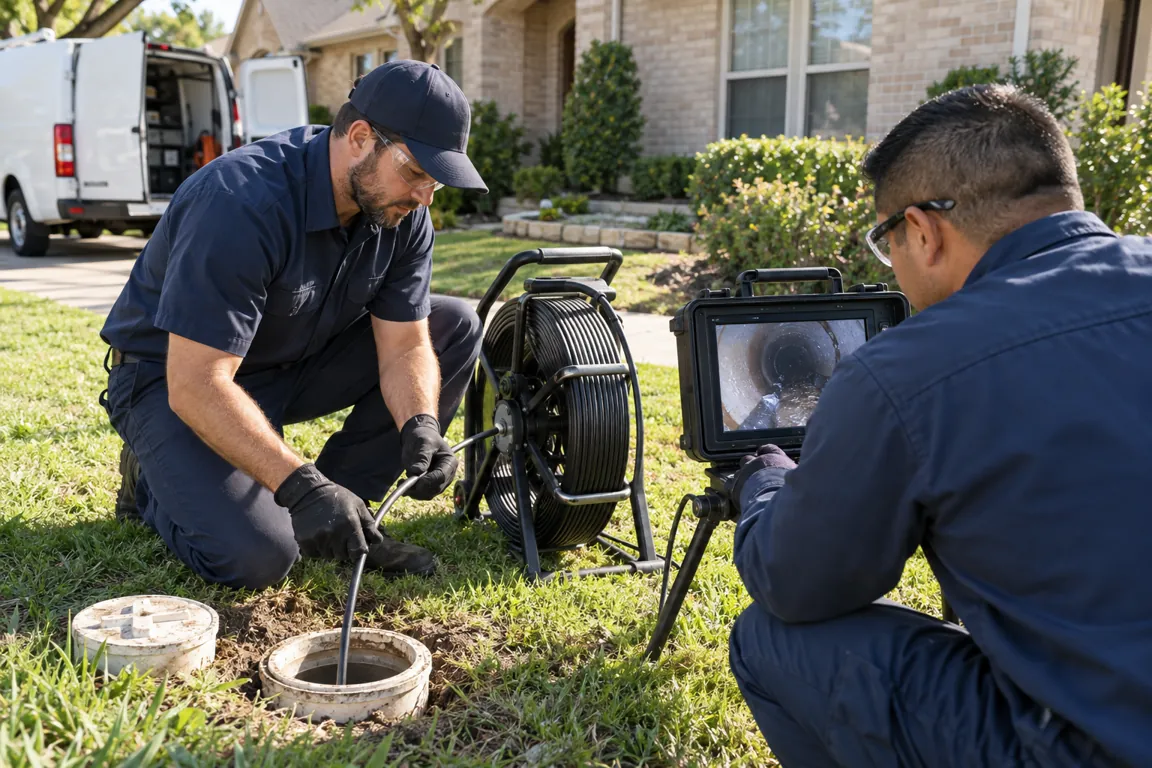
Before recommending a repair, we run a camera through the line to see its actual condition — cracks, offset joints, bellied sections, or root intrusion — instead of guessing from surface symptoms.
Grand Prairie requires anyone digging within a right-of-way in the city to contact the city separately to locate water, sewer, or traffic fiber optic lines, in addition to calling 811 for gas, electric, and other utilities. The city states it requires three full business days to mark the requested area, with exceptions for emergency locates, and that this locating service for city water, sewer, and traffic fiber lines is free.
Repair options we evaluate
Hydro jetting and blockage removal
When the camera shows grease buildup, scale, or root mass without structural damage, hydro jetting clears the line without digging. It resolves blockages, not a cracked or collapsed pipe.
Trenchless repair where the pipe allows it
Trenchless lining can be an option when the existing pipe retains enough shape and structural integrity to support a liner. A collapsed section or severe misalignment usually rules it out.
Spot repair
If the camera finds a single isolated failure point — a cracked joint or short collapsed run — a spot repair addresses just that section rather than the whole line.
Full replacement
Lines with repeated failures, widespread root intrusion, or pipe material nearing the end of its service life are often better served by full replacement than another isolated patch.
Emergency response
Active backups or sewage surfacing in the yard need prompt attention. We prioritize these calls, though we don't promise an exact arrival window — each day's schedule depends on jobs already underway.
What Grand Prairie says about locating lines before you dig
Grand Prairie's wastewater department states plainly that whether you're a homeowner planting a tree or a company digging a foundation, everyone must check for underground utility lines before digging — and that careless digging is a leading cause of underground pipeline accidents, per the City of Grand Prairie.
Texas state law requires calling 811 to locate natural gas, electric, and other underground utilities before any digging project. Separately, if the project involves digging in a Grand Prairie right-of-way, the city requires its own request to locate water, sewer, or traffic fiber optic lines, made by phone to the city or by email to its utility locates address, according to the city's guidance.
After a locate request, crews mark the project area with colored flags or paint showing where lines run, or mark an area 'clear' if nothing is present, and those markings expire after about two weeks, requiring a follow-up request if work is ongoing, per the city's page.
That public locate process covers the city's own water, sewer, and traffic fiber optic lines in the right-of-way — it is separate from identifying the exact path of the private sewer lateral on your own property, which typically requires a plumber or private locating service rather than the city or 811.
Repair vs. replacement decision
Camera findings guide this decision. An isolated defect in an otherwise sound line usually supports a spot repair or trenchless lining. A line with multiple failure points, or one that keeps backing up in different spots despite jetting, points toward replacement.
We walk through the camera footage with you so the reasoning behind the recommendation is visible rather than asserted.
What affects your estimate
Scope depends on factors such as the length of pipe affected, how deep and accessible the line is, whether work crosses a right-of-way requiring a city locate, existing pipe material and diameter, and whether the project needs both a public 811 locate and a private-line locate before digging starts.
We don't publish flat prices because every property's layout and line condition differ. You'll receive a written estimate based on camera findings before any repair work begins.
Common Questions From Grand Prairie Homeowners
How long do Grand Prairie utility markings stay valid?
The city's Call Before You Dig page says crews need about three business days to mark city water, sewer and traffic-fiber lines in the right-of-way, and the marks are only good for roughly two weeks. If a repair is delayed past that window, the locate has to be requested again before digging resumes, so we plan excavation dates around the markings rather than the other way round.
Does Grand Prairie locate my private sewer line before I dig?
The city's locate service covers its own water, sewer, and traffic fiber optic lines within the right-of-way, requested separately from the city. It is not a locate of the private sewer lateral on your own property, which generally needs a plumber or a private locating service.
How long does Grand Prairie take to mark lines before digging?
The city states it requires three full business days to mark a requested area for water, sewer, or traffic fiber optic lines, with exceptions for emergency locates, according to its line locates guidance.
Is calling 811 enough before digging in Grand Prairie?
No. Texas law requires calling 811 for gas, electric, and other utilities, but Grand Prairie separately requires its own request to locate city water, sewer, and traffic fiber optic lines if the project involves digging in a right-of-way.
Does Grand Prairie charge for locating city water and sewer lines?
No. The city states this locating service for city water, sewer, and traffic fiber optic lines is free, per its official guidance.
Related Services and Guides
- Trenchless Sewer Repair
- Sewer Camera Inspection
- Hydro Jetting
- Sewer Spot Repair
- Trenchless vs. Traditional Sewer Repair for Dallas Yards
- 7 Signs Your Sewer Line Is Broken (Not Just Clogged)
- Sewage Backing Up Into Your House? What to Do in the First Hour
Also nearby: Irving, Duncanville · back to our Dallas sewer repair overview.
Local Resources
- City of Grand Prairie – Line Locates (Call Before You Dig)
- City of Grand Prairie – Wastewater
- City of Grand Prairie – Line Locates (Building Inspections)
Official pages are listed for reference. We are an independent plumbing service, not affiliated with the Grand Prairie municipal government.